Case study · Co-founder & Head of AI · Mar 2026 – present
SkyJumper
SkyAI is a CCTV intelligence product for SkyJumper trampoline parks: live at the first center, approved for rollout across 30 centers in 19 cities.
The problem
Party halls were filling beyond their bookings, and the extra guests were revenue the centers did not bill. A booking specifies a guest count, but the front desk had no reliable way to check it.
The proposal: SkyAI uses the cameras already in a party hall to measure headcount, compares it with the booking, and issues an alert with evidence frames when a party exceeds it.
How it behaves
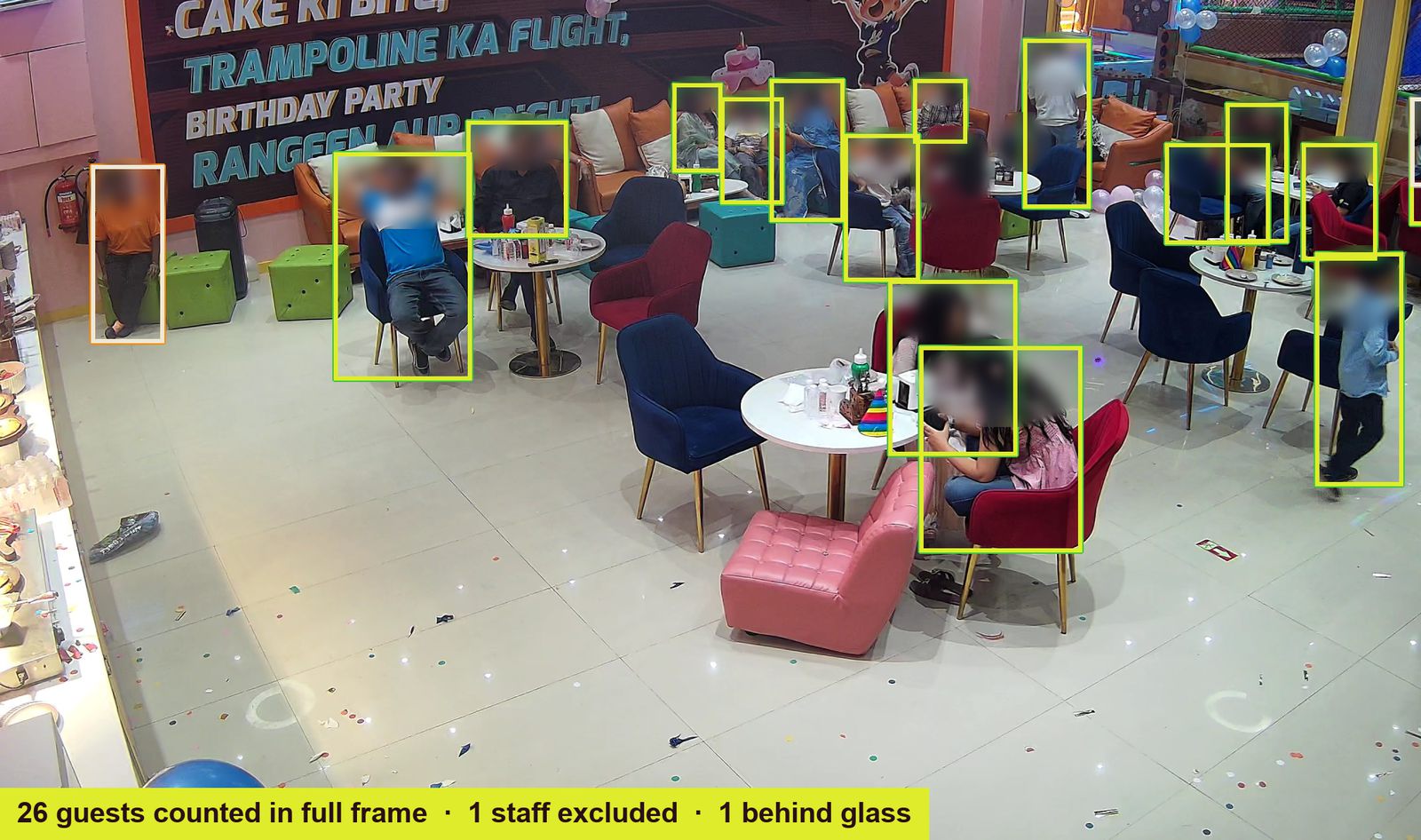
- Booked
- 24
- Counted
- 21
Within booking.
A simulation of the same logic. Guest footage stays private.
The dashboard
Management works from a React dashboard: an overview of each center, a per-party view of booked against counted guests over time, and a summary of the value of over-booking.
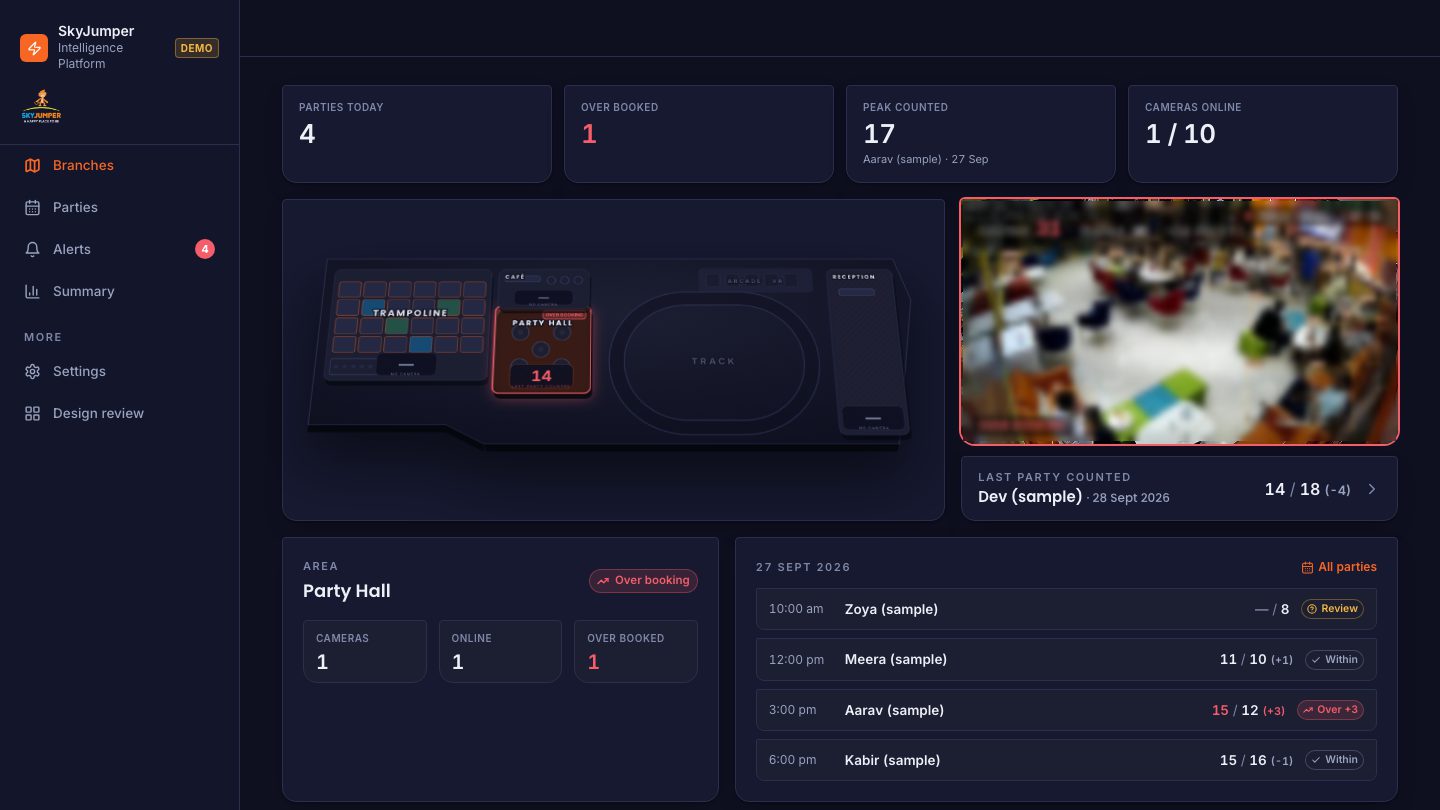
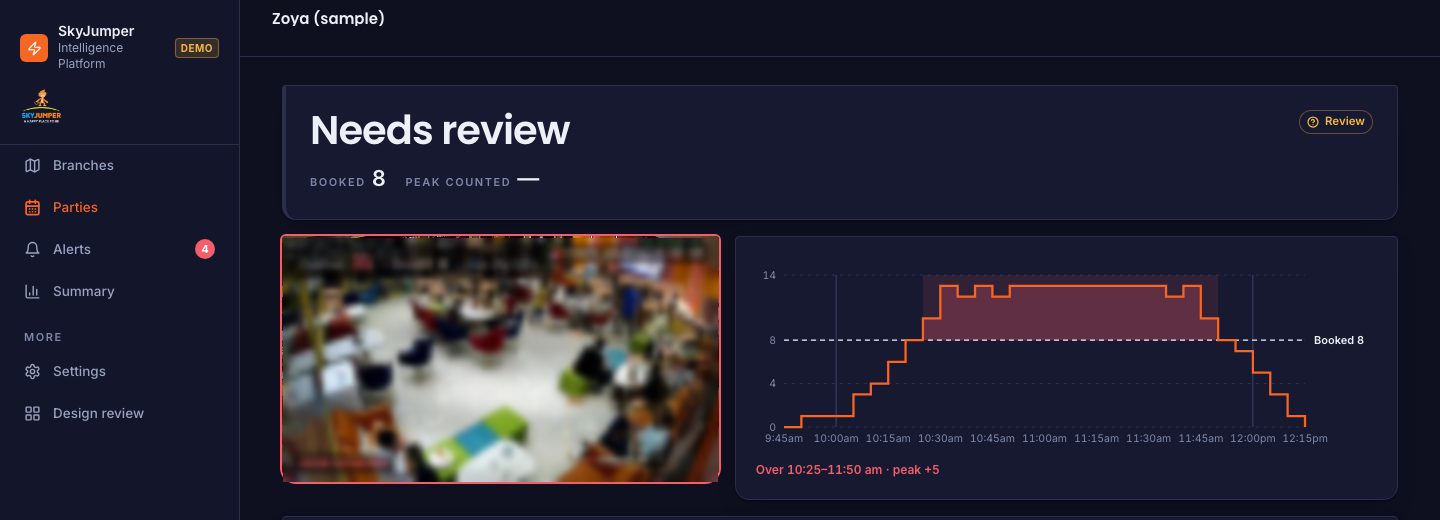
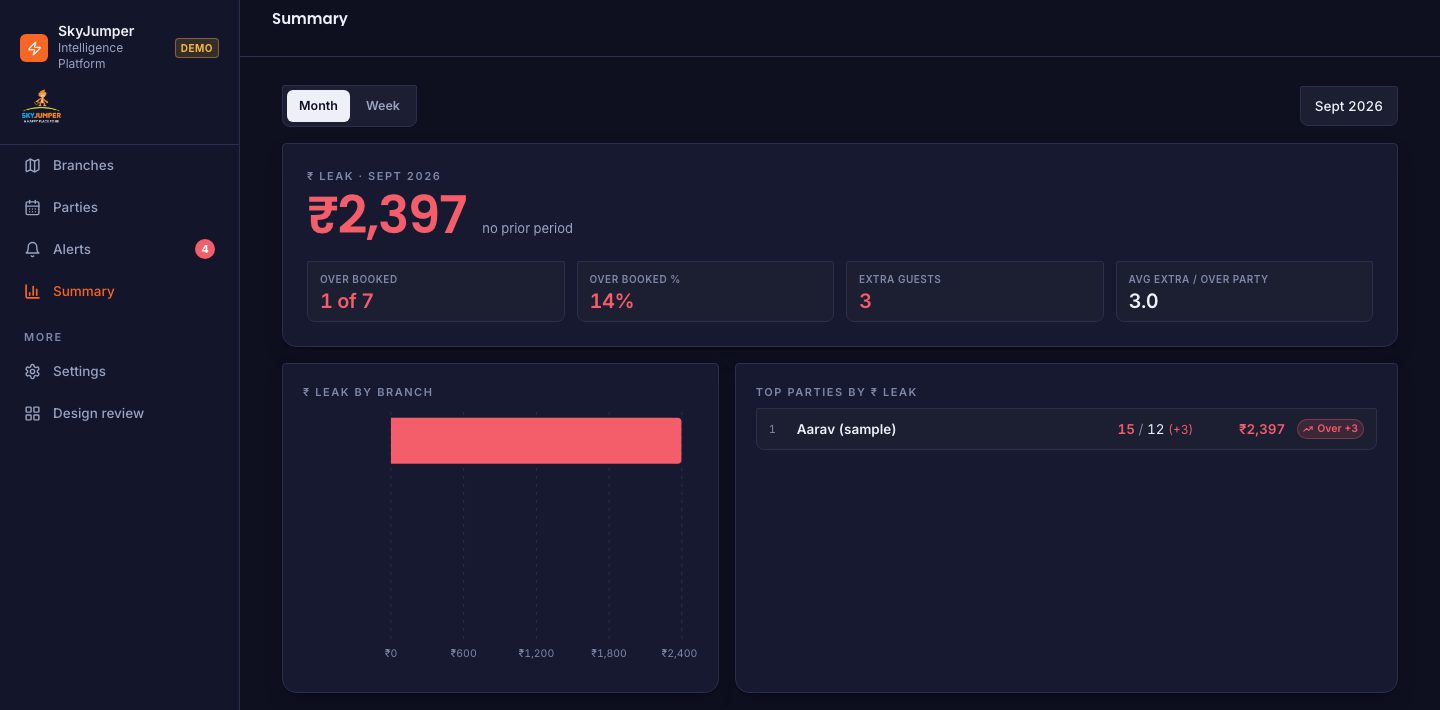
Screens from the product's demo mode, with sample parties and values. Center names are removed and camera frames are blurred.
What must not be counted
A person-shaped detection is not always a guest. The evaluation separates staff, glass reflections and décor from guest counts on 4K video.
Architecture
Each center runs its own edge node. The node owns the video and keeps working if the network drops. Raw video stays on site by default.
At the center
- 4K party-hall camera and NVRRTSP capture from the site recorder
- Jetson edge nodePerson detection and multi-object tracking
- Metrics and evidencePer-area headcount and per-party counts, served by FastAPI
Central
- Live APICloudflare Pages Functions, D1 and KV
- React dashboardFor management
- Alerts and reportsOver-booking alerts, weekly PDFs
Tech stack: YOLO11n · ByteTrack · NVIDIA Jetson Orin NX · FastAPI · React and Vite · Cloudflare Pages Functions, D1 and KV · RTSP and NVR integration
Proving it works
Accuracy is measured against hand counts, under preregistered evaluations. Frames from the same event are near-duplicates, so event-level leakage control keeps them from landing on both sides of a split.
| Result | Measure | Sample |
|---|---|---|
| 90% | within 2 people of a hand count | 205 moments, about 1 person average difference |
| 93% | within 2 people on held-back parties | 60 moments |
| 100% | within 2 people on held-back parties of up to 30 guests | 51 moments |
| 4 of 4 | over-booked test parties flagged | 4 test parties |
Revenue recovery
Every guest above the booking is revenue a center did not bill.
The system compares the counted guests with the booking, flags the parties that exceed it and attaches evidence frames. The summary screen totals over-booked parties, extra guests and their value by center and by party. Extra guests that are then billed are recovered revenue.
Projected- per center per year
- ₹8–20 lakh
- a year across 30 centers, about $0.3–0.7M
- ₹2.4–6 crore
These are forecasts from the business case, not realized results. POS integration is in progress.
Where it stands
- Live
- At the first center: party-hall counting, booked-versus-counted checks, over-booking alerts with evidence frames, a reception queue service, a management dashboard and weekly PDF reports.
- Approved
- Rollout across 30 centers in 19 cities. The rollout footprint is 30+ centers and 1,000+ cameras.
- In progress
- POS integration.
- In development
- Staff face recognition across centers, the next phase.
- Projected
- ₹8–20 lakh recovered per center per year, or ₹2.4–6 crore (about $0.3–0.7M) a year across 30 centers. A forecast from the business case, not a realized result.
Getting to 30 centers
- I own the edge deployment path from the first commissioned Jetson node to multi-city rollout.
- That covers site surveys, camera and NVR integration, RTSP capture, remote operations and per-center configuration with no branch-specific code.
- The rollout footprint is 30+ centers and 1,000+ cameras. I coordinate on-site IT staff across 19 cities for installation, and lead a core AI and management team of 4–5 people.
- Linking the system to the POS is in progress. The next phase, staff face recognition across centers, is in development.
The business side
- Worked with SkyJumper's CEO, operations and software leadership, from problem discovery through proposal, go-live and rollout planning.
- Built the business case and commercial proposal, including the projected recovery above.
- Turned raw video into metrics managers use: per-area headcount, per-party counts and booked-versus-counted reports.